Capitalism got us into this mess. Will it really get us out?
This piece was originally written as an essay for a course at John Jay College taught by Geert Dhondt.
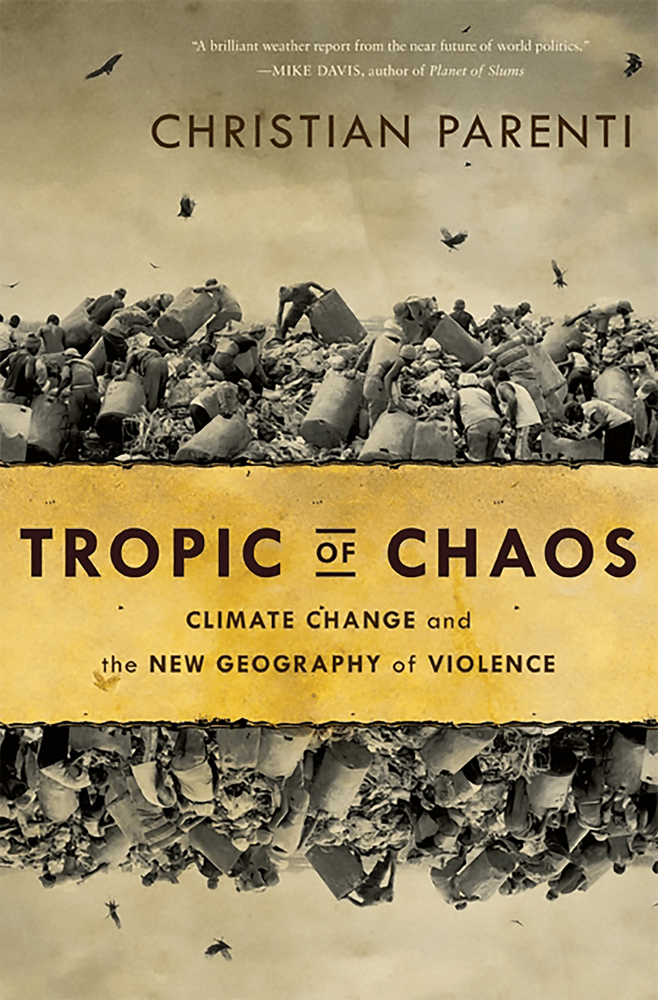
We have all heard that climate change is going to upend our lives, according to some, in the very near future. However, those of us lucky enough to live in the United States and other well positioned countries have yet to see major direct effects of the climate crisis on our everyday lives. Not everyone is so lucky. In Tropic of Chaos, Christian Parenti explores the ways that climate effects have already upset the status quo in developing countries around the globe, and how the runaway effects of climate change have a compounding weight on preexisting injustice and inequality.
It’s no secret that the behavior of governments and corporations has lagged behind the science of climate change. There is a lot of talk about improving climate outcomes and taking responsibility, with little concrete steps being taken. In fact, often it seems the right and does not know what the left is doing—press offices preach climate awareness, while new drilling sites are opened and banks serve out loans to polluters. This is not unlike the world of international development. Western governments may gesture towards fairness and opportunity for all nations in principle, while in practice they pull up the ladder behind them, exploit neocolonialist power dynamics, and force nascent economies to liberalize and be violently exposed to the pains of free trade. Christian Parenti attempts to link these two processes, showing the ways that climate crisis exacerbates the already dire situations created by neoliberalism, and how these collisions are creating a catastrophic convergence. Parenti succeeds in connecting the climate crisis to a wider landscape of exploitation, and is convincing in his argument that this catastrophic convergence will lead to none other than a full scale crisis, not just climatically, but politically and economically. His book is a masterwork when it comes to synthesizing on the ground reporting with historical and scientific research, and despite the wide scope, the book paces well, linking ethnic crises in one region with resource shortages in another effectively. However, where Tropic of Chaos loses steam is in its confusingly weak conclusion, which claims the only way out of the climate crisis is the way we got into it: placing our economy and our world in the hands of capitalists.
Parenti takes the reader around the Global South, showing the ways that neoliberal economic ruin and climate change are converging, with brutal consequences. As an introduction, we are introduced to the case of Ekaru Loruman, a shepherd-soldier of the Turkana tribe in northwest Kenya. Loruman was shot dead by a member of the Pokot, a competing tribe, in a typical example of cattle theft. Seems like a straightforward case of tribal violence, no? Instead, Parenti makes the argument that Loruman was killed by much greater forces: “the catastrophic convergence of poverty, violence, and climate change” (5). Setting the stage, Parenti takes a wide review of the available climate literature to make the argument for a Tropic of Chaos. Between the Tropics of Cancer and Capricorn, economically unstable postcolonial nations, many heavily dependent on fishing and agriculture, are finding themselves on the front lines of climate change. The outright violence of so-called small wars and economic violence of forced liberalization have left these nations reeling. This belt of unrest and violence is seen by Western nations first and foremost as a global security threat, Parenti argues. The military-industrial elite of the United States talks in the vocabulary of armed lifeboat politics. Counterinsurgency and policing of failed states are the main strategies for coping with the suffering climate change has wrought and will continue to bring to the Global South. This counterinsurgency action “ruptures and tears (but rarely remakes) the intimate social relations among people, their ability to cooperate, and the lived texture of their solidarity” (23). By dissolving social relations, counterinsurgency tactics therefore leave people more exposed to the violence of deprivation that comes with climate change, and the pernicious cycle continues. Thus, as follows is the crux of the issue: “Because counterinsurgency is a war that, by design, attacks the social fabric, it has sowed chaos and set the stage for the catastrophic convergence. … And now, armed adaptation is set to double down on a bad bet by applying more counterinsurgency to the global matrix of crisis” (36). Parenti argues that nations in the Tropic of Chaos have been used and abused by Western nations, and that it will only get worse as the climate crisis forces hard decisions and untenable situations, nationally and internationally.
By synthesizing examples from all around the world, Parenti is able to convincingly make the case for a wider global movement. Tropic of Chaos is organized into different sections, the first an introduction, and the rest organized by continent: Africa, Asia, and Latin America. Each section contains chapters that detail catastrophic convergences in specific countries and regions. Conclusions are drawn equally from cattle rustlers in the Great Rift Valley as energy crises in Kyrgyzstan, or narco-wars in Northern Mexico.
Tropic of Chaos contains a unique blend of meticulously researched arguments, fitting for a university researcher, and first-person experiential writing on par with a gonzo journalist. This contrast allows Parenti to educate the reader, and make sound arguments, without losing the reader in the weeds of climate reports and weather statistics. By connecting his own testimony on the ground with the climate research, Parenti is much more impactful, and his words carry more weight. His experiences and perspectives are just tantalizing enough to keep the reader interested, without detracting from the continuous message of the book. I was almost disappointed when each passage of his own experience ended, but in retrospect he successfully toed the line of grounding the reader without becoming too granular.
The final section hits closest to home for Americans, geographically and politically. Parenti analyzes the catastrophic convergences taking place in Latin America, including Brazil and Mexico, before turning his sights towards political reactions and possibilities in the United States and elsewhere. Immigration rhetoric in the United States, while energetic and often racist, is not often connected to climate change. Parenti argues that this connection is underrecognized, and will continue to grow as time goes on. As the armed lifeboat model continues to be the most popular vehicle for climate preparedness, Americans who are used to the idea of persecuting immigrants, refugees, and asylum-seekers will see little problem with a similarly zero-sum approach to the climate crisis.
Most of Tropic of Chaos is not focused on predicting the future but instead documenting what has already been occurring in the hopes of changing the trend. In the final chapter, however, Parenti does prescribe some recommendations and ideas for the future. According to Parenti, the climate crisis is too big and immediate a problem to be solved by means other than existing power structures. Parenti believes “time has run out on the climate issue. Either capitalism solves the crisis, or it destroys civilization” (241). This thinking is flawed. One of the reasons that the climate crisis is so out of control is that the current capitalist political and economic system has created incentive structures for corporations, and by extension the politicians they fund, to continue destroying the planet in favor of profit. Parenti argues that transforming our political and economic systems must be put on hold so that we may transform the energy economy first. Then, “other necessary changes can and will flow from that” (241). On what ground does the assertion that other necessary changes can and will flow stand? Why would transforming the energy economy necessarily begin to create change away from a capitalist system? These questions go unanswered by Parenti. Before we can even get to those questions, we must accept the premise that the energy transition can be performed by the capitalist powers that be.
Parenti compares this energy crisis to that of sanitation in the early 19th century. If capitalism could solve that problem, and clean up cities in the name of public health, then they should be able to solve the energy emergency (242). However, progress in sanitation was not caused by capitalism, rather it happened in spite of capitalism. After medical experts agreed that trash and waste was dangerous to human health when left untreated, public pressure for sanitation mounted, and governments were forced to act. I see that as less as a ringing endorsement for a capitalist system, and more as an example of the necessity for people to agitate and create change, against the interests of the rich (even though science was indeed on the side of the people). Parenti does admit that “capitalism may be, ultimately, incapable of accommodating itself to the limit of the natural world,” but bizarrely couches the issue of greenhouse gas emissions as something that can and should be solved within the capitalist system (241). Parenti, as demonstrated over the course of this book, has no misgivings about the capabilities of capitalists and their governments. Most of this book is his argument that capitalist exploitation is the reason why climate catastrophe will hit some countries harder than others, and why that pain will continue once Western nations fortify and close up to those suffering the worst effects. It is unclear why he chose to pivot now, at the very end of the book, to a viewpoint forgiving to and understanding of the capitalist system that has so vigorously worked against the many people and organizations around the world who fight every day for political, economic, and climate justice.
Tropic of Chaos is a monumental effort by Christian Parenti to unite seemingly disparate populations and problems by linking them to the convergence of climate crisis and political and economic violence. For students of economics or environmental studies, this book will provide perspectives and ideas not usual to each field. The text is thick with details from climate reports and historical documents, while also anchored by Parenti’s own experiences in places as far as the poppy fields of Afghanistan. However, what was shaping up to be masterwork is tainted by an uninspiring, even confusing conclusion. By claiming that capitalism alone can solve the problem of the energy transition, and therefore the climate crisis, Parenti all but contradicts himself, and loses much of the credibility he built up over the course of an insightful and biting first nine-tenths of Tropic of Chaos.
 Paul Hedreen
Leave a comment